
Multimedia content
- Images (1)
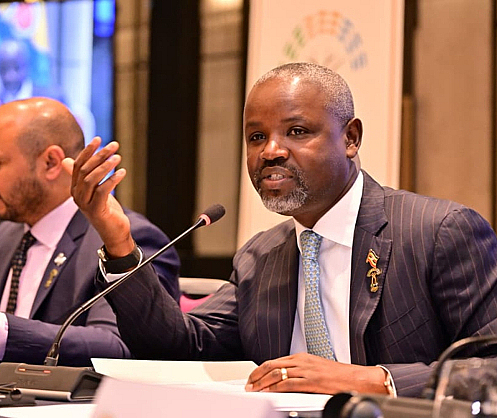
- Deputy Speaker Tayebwa (R) chaired the OACPS assembly
- All (1)
Uganda: Unite in negotations with the Eureopan Union - Tayebwa
Delegates from several countries also called for reforms, saying that the existing international financial system does not adequately account for the vulnerability of countries facing repeated climate disasters
Deputy Speaker Thomas Tayebwa has urged African, Caribbean and Pacific legislators to close ranks and negotiate with the European Union as a united bloc, saying their collective strength will determine their influence on international trade, investment, climate finance and development.
Tayebwa made the call as he chaired the 65th session of the Organisation of African, Caribbean and Pacific States (OACPS) Parliamentary Assembly in Brussels on Sunday, 08 November 2026. It was his first session as the assembly's president.
Tayebwa argued that Europe's ability to negotiate as a regional bloc gives it considerable influence in international engagements, a model the OACPS should emulate to advance the interests of its member states.
“When we are engaging with our European countries, you will not hear them talking about their country. They will be talking about Europe as a region. We want in our engagement tomorrow with our European counterparts to be guided by unity,” Tayebwa said adding that, ’when you are speaking, you are speaking for Africa, the Caribbean, for the Pacific, not just for your country. That's the only way we shall be able to match these people’.
The appeal comes as he seeks to strengthen the OACPS's institutional structures and redefine its role in international parliamentary diplomacy under the Samoa Agreement, which provides the framework for cooperation between the organisation and the European Union.
The agreement covers areas of mutual interest, including trade, investment, sustainable development, climate change, governance, peace and security. Its implementation provides a framework through which member states can advance their development priorities in partnership with the EU.
OACPS Secretary-General Moussa Batraki also appealed to delegates to make the organisation's diversity a source of strength rather than a barrier to collective action.
“Our collective force resides precisely in this ability to combine the diversity of our priorities and the solidarity that unites our 79 member states,” he said.
Batraki noted that the new parliamentary architecture emerging under the Samoa Agreement places an additional responsibility on the organisation to preserve its unity while allowing each region to articulate its particular interests.
Tayebwa also raised concerns about the slow ratification of the Samoa Agreement by member states.
“I encourage colleagues to follow up with their national authorities so that ratification moves fast and we move from provision to full implementation,” he said.
Another major issue discussed was the assembly's financial sustainability. Tayebwa has been pushing for mechanisms to finance its activities without depending entirely on support from the European Union.
He said institutional reforms and changes to the assembly's rules would have limited impact if the organisation lacked the resources to implement its priorities.
“Reliable financing is essential if we are to organise our own activities and follow through on our priorities. We cannot continue to depend on external support only to determine when and how we meet,” he said.
His proposal received support from the regional groups, with Pacific Regional Parliamentary Group President Renata Tamapua backing the establishment of a common parliamentary fund.
She said contributions should take into account the financial capacities of member states, geographical constraints and high travel costs. She also emphasised the need for predictable and sustainable financing to support the assembly's activities between formal sessions.
At a later session of the assembly, it was resolved that the Organisation of African, Caribbean and Pacific States (OACPS) puts climate change financing at the centre of its discussions with the European Union (EU), with member states calling for reforms to ensure that vulnerable countries can respond to climate shocks without accumulating more debt.
Tayebwa said member states must collectively demand climate justice and ensure that the countries responsible for the largest share of global emissions bear the cost of addressing climate change.
He said African, Caribbean and Pacific countries were experiencing severe climate impacts despite contributing relatively little to global emissions.
“The ones who are emitting a lot are not feeling the impact, as we are, who are emitting less. If you look at the OACPS countries, in total, we don't emit more than, on average, more than six per cent. But the impact is huge on us,” Tayebwa told delegates.
He pointed to rising sea levels, coastal erosion and damage to coral reefs in the Caribbean, drought, hunger and famine in Africa, and increasingly difficult conditions facing countries in the Pacific. He contrasted these with the experiences of wealthier countries, which have greater financial resources to invest in adaptation measures and protect their populations.
Delegates from several countries also called for reforms, saying that the existing international financial system does not adequately account for the vulnerability of countries facing repeated climate disasters.
Dwight Sutherland, the Barbados delegate, said climate change posed an immediate threat to the economic stability of small island developing states, extending beyond environmental concerns to affect their ability to finance development.
He called for support for the Bridgetown Initiative, which aims to reform international financial arrangements so that climate-vulnerable countries can access affordable financing and respond to disasters without undermining their development priorities.
“The Bridgetown Initiative seeks to reform the international financial architecture so that climate-vulnerable countries can respond to shocks, invest in resilience, and finance their development on affordable terms,” Sutherland said.
Distributed by APO Group on behalf of Parliament of the Republic of Uganda.
Deputy Speaker Tayebwa (R) chaired the OACPS assembly