
Multimedia content
- Images (1)
- A taste of fonio: Food and Agriculture Organization of the United Nations (FAO) puts an ancient African grain in the spotlight in Accra
- All (1)
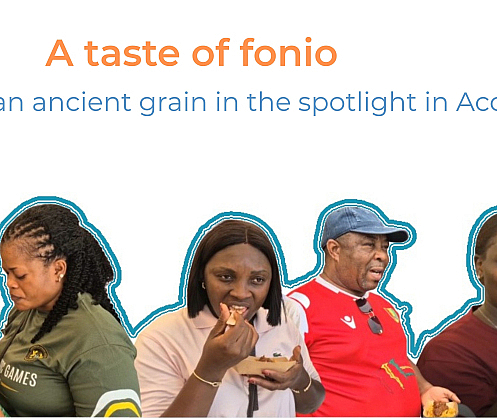
A taste of fonio: Food and Agriculture Organization of the United Nations (FAO) puts an ancient African grain in the spotlight in Accra
Diplomatic community gets a taste of fonio jollof prepared by FAO Regional Goodwill Ambassador for Africa Chef Fatmata Binta
“You guys should try fonio, it’s really good.” That was the verdict from one of the many visitors tasting fonio at the Food and Agriculture Organization of the United Nations (FAO) stand at a diplomatic community event hosted by Ghana’s Ministry of Foreign Affairs in Accra on Saturday.
FAO set up the stand as an advocacy initiative to introduce more people to fonio, an ancient West African grain with significant potential for food security, nutrition, climate resilience and livelihoods.
Visitors were served fonio jollof prepared by FAO Regional Goodwill Ambassador for Africa Chef Fatmata Binta, a leading advocate for fonio and indigenous African foods.
For many, it was their first taste of the tiny grain. The reaction was overwhelmingly positive, with visitors praising its taste and texture and comparing it variously to rice, couscous, semolina and quinoa.
“Fonio connects so many things that matter to me: our heritage, our environment and the livelihoods of African women,” said Chef Binta. “When we put fonio on people’s plates, we are not just introducing them to a new food. We are creating demand for a crop that women have grown for generations and showing that our indigenous ingredients have a place in the future of food.”
Fonio has been cultivated across West Africa for generations. The grain can thrive in marginal soils and with relatively low rainfall and inputs. Once harvested, it is also remarkably versatile: it can be cooked as a grain, served as porridge, used in place of rice or couscous, or milled into flour for baking.
Despite these qualities, fonio remains underutilized and unfamiliar to many consumers. FAO has been working with Chef Binta to change that by supporting both ends of the value chain: helping women farmers improve production and processing while encouraging more consumers to discover and eat the grain.
“Fonio is part of Africa’s food heritage, but it also has an important role to play in Africa’s food future,” said Meshack Malo, FAO Deputy Regional Representative for Africa and Representative in Ghana. “By increasing awareness and demand for crops like fonio, we can support more diverse and resilient agrifood systems while creating new opportunities for the farmers, particularly women, who produce them.”
Better production, stronger markets
FAO, Ghana’s Ministry of Food and Agriculture and Chef Binta have trained around 100 women fonio producers in Chereponi in Ghana’s North East Region. The hands-on training covered improved production and post-harvest practices, from seed selection and planting methods to harvesting, processing, packaging and market access.
Importantly, the initiative helped address one of the biggest constraints facing women producers: the labour-intensive processing of the tiny grain. Chef Binta’s Fulani Kitchen Foundation provided processing machines, and the women received training in their use, helping them process larger quantities of higher-quality fonio for sale. Processing 60 kg of fonio using traditional methods can take nearly two weeks. With mechanized equipment, 5 kg can be processed in just five minutes.
But increasing production alone is not enough. Building markets and encouraging more people to eat fonio are also essential to generate greater income and livelihood opportunities for the women who produce it.
FAO has also produced a Ghana fonio value chain analysis, due to be released soon, which identifies significant potential to scale up production, create jobs and increase incomes, particularly for rural women, through greater investment in mechanization, value addition and stronger markets.
The diplomatic community event in Accra was another step in that effort, taking fonio from the fields of northern Ghana to new plates and new audiences.
Distributed by APO Group on behalf of Food and Agriculture Organization of the United Nations (FAO): Regional Office for Africa.

A taste of fonio: Food and Agriculture Organization of the United Nations (FAO) puts an ancient African grain in the spotlight in Accra